h500 what screws to use with stand offs
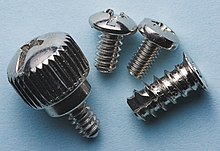
From left to right: a #6-32 UNC thumbscrew, a #6-32 UNC screw, an M3 screw and a cocky-borer spiral for case fans
Reckoner case screws are the hardware used to secure parts of a PC to the case. Although there are numerous manufacturers of computer cases, they have mostly used iii thread sizes. The Unified Thread Standard (UTS) originates from the U.s., while the ISO metric screw thread is standardized worldwide. In turn, these thread standards define preferred size combinations that are based on generic units—some on the inch and others on the millimetre.
The #6-32 UNC screws are often found on 3.5" hard disk drives and the case's trunk to secure the covers. The M3 threaded holes are often found on 5.25" optical disc drives, iii.v" floppy drives, and 2.5" drives. Motherboards and other circuit boards often apply a #six-32 UNC standoff. #4-xl UNC thumb screws are often plant on the ends of DVI, VGA, series and parallel connectors.
More than modern cases from sure manufacturers (Dell, Gateway) and enthusiast cases volition lack screws altogether, instead utilizing a tool-less design.
#6-32 UNC screw [edit]

The #6-32 UNC spiral has a thread pitch of ane/32 in (0.031250 inches (0.7938 mm)).
The #6-32 UNC is a UTS screw specifying a major thread diameter of #six which is divers as 0.1380 inches (3.51 mm); and 32 tpi (threads per inch) which equates to a thread pitch of 0.031250 inches (0.7938 mm). The optional UNC specification indicates the standard fibroid thread is used which is divers for #6 screws as 32 tpi rendering 'UNC' redundant, however it may be seen when other specifications such as plating or other treatments are also specified. It is by far the most mutual screw plant inside reckoner cases.[i] [ self-published source? ] It ordinarily appears in lengths of three/16 in (0.1875 inches (4.76 mm)) and i/4 in (0.25 inches (vi.4 mm)) or less oftentimes 5/16 in (0.3125 inches (seven.94 mm)). Non-standard metricized lengths such equally 5 millimetres (0.20 in) are besides sometimes encountered. Almost every make new computer case comes with a pocketbook of these. They are commonly used for the post-obit purposes, however there are many exceptions:
- securing a power supply to the case
- securing a 3.5-inch hard disk bulldoze to the case
- holding an expansion card in identify by its metal slot cover
- fastening case components to one another
- usually, one or more #6-32 UNC screws hold the main cover on the example
They are almost ever provided with a #two Phillips drive. Sometimes a Torx drive is used instead. Both Phillips and Torx patterns may also be combined with a slot for a flat-bract screwdriver. Normally they are provided with a 1/four in (0.25 inches (half-dozen.4 mm)) flanged hex head. Non-standard metricized five.5 millimetres (0.22 in) flanged hex heads can besides be encountered. Too common are pan head screws - a low deejay with a chamfered outer edge. Because they are used in places where high torque is not required and easy removal and replacement may be desirable (such every bit on the side panels of the PC example), they are frequently available as thumbscrews with larger, knurled heads that tin can be removed with one's fingers or tools.
M3 screw [edit]
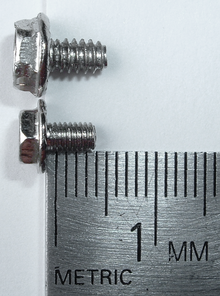
The M3 screw (lesser) has a thread pitch of 0.5 millimetres (0.020 in), which is finer than the 0.031250 inches (0.7938 mm) pitch of a #6-32 UNC screw (top).
The M3 is a metric screw specifying a nominal bore of 3 millimetres (0.12 in); and standard fibroid thread pitch divers equally 0.5 millimetres (0.020 in). The M3 is the 2nd nigh common screw found in PCs.[1] [ self-published source? ] It commonly appears in many lengths from 1 to 20 mm. Nearly every make-new estimator case comes with a pocketbook of these. Nonetheless many exceptions, they are commonly used for securing the following devices:[2] [3]
- 5.25-inch optical disc drives
- 2.5-inch hard disks and solid-state drive
- iii.5-inch floppy drives
M3 screws typically accept a #two Phillips screwdriver tip.
Motherboard standoff [edit]

Various types of motherboard standoffs
Nigh cases employ threaded brass standoffs (Jack Screw Standoffs) for attaching the motherboard to the instance chassis. Because the instance material is commonly a conductive metallic, attaching the motherboard direct to it can crusade a short circuit. Sometimes threaded or snap-lock plastic standoffs are used, which are less secure, but every bit useful in a stationary figurer. The standoff provides a margin of space between the motherboard and the case to keep the multiple solder points beneath from grounding and short-circuiting.
Usually, the standoff has a #half-dozen-32 UNC male thread on one end which screws into a threaded hole in the case or motherboard backplate and a #6-32 UNC female thread in the other stop which accepts a spiral to retain the motherboard. Less ofttimes, the standoff has a female person thread in both ends and a second screw is used to attach information technology to the example. Some standoffs utilise the M3 female person thread (which faces the motherboard) instead of #6-32 UNC, and on a rare occasion a mixture of types can be used in the same case.
All-metric standoffs are stated as threading 10 hex length x threaded length. For example, M3 x ten x 6 means a collision with M3 male and female person threading, ten mm hex length, and half-dozen mm threaded length. M6 ten 10 x 8 ways M6 male and female threading, 10 mm hex length, and 8 mm threaded length. Typically, M2.5 and M3 standoffs tighten with a 5 mm socket, M4 standoffs with a half-dozen mm socket, M5 standoffs with a 7 mm socket, and M6 standoffs with an 8 mm socket, only this is not always the example.
Version 2.1 of the ATX specification states that the length of standoffs needs to be at to the lowest degree 0.25 inches (six.4 mm), with their cantankerous sections fitting within 0.40 by 0.40 inches (10 mm × 10 mm) square areas centered around each mounting hole on ATX motherboards.[4]
#4-40 UNC thumbscrews [edit]
Pairs of #4-forty UNC thumbscrews are used to fasten sure connectors to hardware ports. The screws are typically located on either side of D-subminiature connectors such as on VGA, serial, parallel and legacy game controller ports. They are besides more recently used on DVI connectors. The typical length for a #four-40 screw used in PCs is three/xvi in (0.1875 inches (4.76 mm)). Occasionally the four-40 hexagonal standoffs come loose when loosening the 4-40 screws to remove a cable, gender changer, or adapter. The 4-40 standoffs typically tighten with a 5 mm or 3/16-inch socket. Care should be taken not to overtighten them equally they are somewhat delicate and will snap off at the base with excessive torque.
Material [edit]
Steel is by far the most common textile used, frequently with a plated or anodized finish. Other materials including brass, aluminum, nylon and various plastics are as well used for applications with detail physical or artful requirements.
Comparison [edit]
The #6-32 UNC is a thicker screw with a more than coarse thread. This makes information technology more suitable for fastening larger parts and thicker materials requiring increased holding force. Its larger size and coarse thread arrive easier to piece of work with during associates, with less run a risk of cantankerous threading. The integrated flange provides greater holding forcefulness with less risk of pull through. The hex head makes it easier to work with during assembly with powered torque screwdrivers.
The M3 is a thinner screw with a finer thread than the #half dozen-32 UNC. This makes it more suitable for fastening into smaller parts and thinner materials requiring practiced strength in a limited space. Its size and fine thread brand information technology appropriate for applications where a #6-32 UNC would be excessively bulky without providing any other benefits versus the smaller M3.
Gallery [edit]
-

Close-up of a #6-32 UNC screw with a flanged hex/Phillips caput, usually provided in PC cases
-
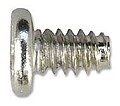
Shut-up of a #half-dozen-32 UNC spiral with a Phillips pan head, commonly provided in PC cases
-

Thumbscrews from an ATX PC example
Case [edit]
A regular computer example may crave/include[v]
- seven thumb screw 6-32 × 6 mm for 2.5" bulldoze tray, expansion slots
- 4 hexagon screw six-32 × six mm for psu
- 21 phillips screw 6-32 × five mm for motherboard, 3.v" harddisk tray
- 12 phillips screw M3 × 5 mm for ii.5" harddrive
- xvi KB5 10 x mm for fans
- 9 collision 6-32 × half dozen.5 + 4 mm for motherboard
- one positioning standoff 6-32 × 6.5 + 4 mm for motherboard
Meet also [edit]
- Torx
References [edit]
- ^ a b Rutter, Daniel Dan's Information - Messages 53, "Screwed", 2006-02-26
- ^ "two.5-inch Hd Drives Installation Guide" (PDF). HGST. January xxx, 2007. Archived from the original (PDF) on December 24, 2012. Retrieved November sixteen, 2014.
- ^ admin (2022-03-eleven). "Which screws practice I use to install the motherboard onto the standoffs?". Retrieved 2022-03-22 .
- ^ "ATX Specification, Version 2.1: Section 3.four.two Secondary (Bottom/Solder) Side Height Constraints" (PDF). formfactors.org. 2012-08-eighteen. p. 18. Archived from the original (PDF) on 2016-08-17. Retrieved 2014-12-22 .
- ^ "H500 Transmission" (PDF). NZXT. Retrieved 17 June 2021.
External links [edit]
- The eleven Tools Every System Builder Should Own (and screws) from crn.com
Source: https://en.wikipedia.org/wiki/Computer_case_screws

ارسال یک نظر for "h500 what screws to use with stand offs"